What Is GEO, and Is It Any Different From AEO?
GEO stands for Generative Engine Optimization, the work of getting your business named inside the answers AI tools write. It sounds like a brand-new discipline with a brand-new price tag attached. It’s mostly a new word for work you may already be paying someone to do.
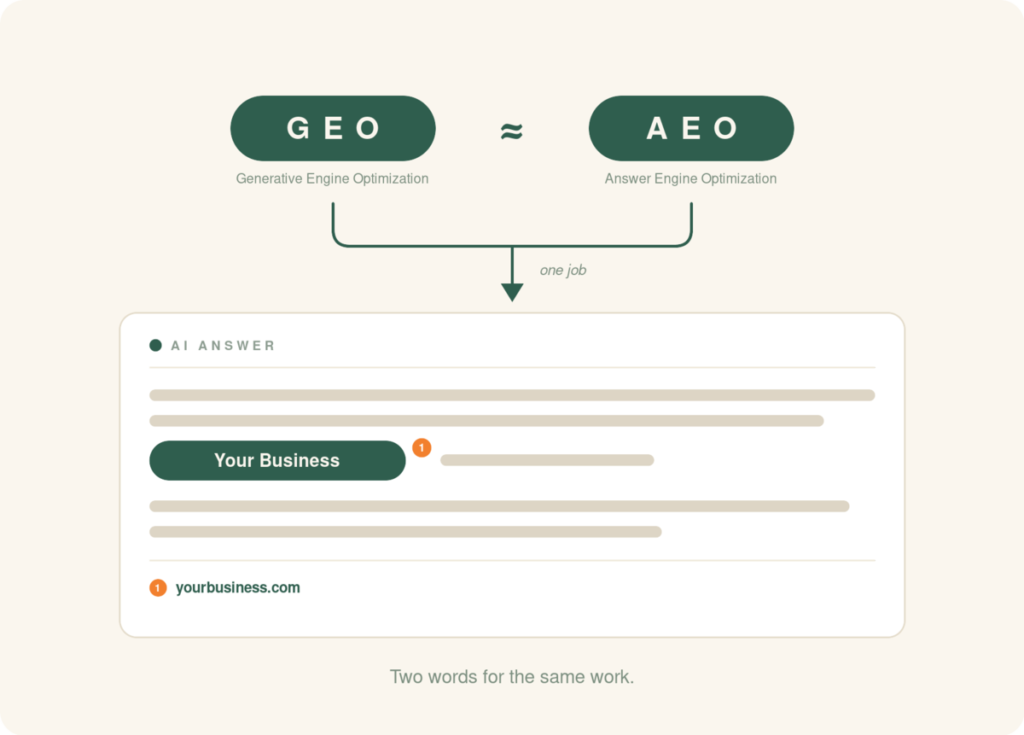
There’s a vocabulary problem in this corner of marketing, and it’s quietly costing business owners money. GEO and AEO get sold as two separate services by people who have two separate things to sell. In practice they describe nearly the same work. Knowing that can save you from buying the same job twice.
What “GEO” actually means
GEO stands for Generative Engine Optimization. It means getting your business cited inside the answer an AI tool writes, rather than in a list of links underneath it.
When someone asks ChatGPT or Perplexity to recommend a plumber in their town, the tool doesn’t hand back ten blue links and let them sort it out. It writes a short paragraph, names a couple of businesses, and stops. Being one of the businesses it names is the whole objective. Everything filed under GEO is in service of that one outcome.
Where the term GEO came from
GEO was coined in a research paper, not by an agency. That’s unusual enough in this field to be worth a minute.
In November 2023, a team of academic researchers published a study called “GEO: Generative Engine Optimization”, later accepted to KDD 2024, one of the field’s major data-mining conferences. The paper describes the problem more plainly than most marketing does:
Given the black-box and fast-moving nature of generative engines, content creators have little to no control over when and how their content is displayed.
Aggarwal et al., GEO: Generative Engine Optimization, KDD 2024
That’s the honest version of what every business owner is now up against. You can’t see inside the machine, and the machine is deciding whether to mention you.
The academic origin also explains a tone difference you’ll notice reading around. GEO language leans technical, because it started in a lab. AEO language leans practical, because it started with marketers trying to explain a problem to clients. The two words are aimed at the same target.
What the GEO research actually found
The headline number is 40%. That’s how much the paper’s methods lifted a source’s visibility inside AI-generated answers.
The researchers built a benchmark of 10,000 real queries across a range of domains, then tested a set of tactics to see which ones actually moved a source up in the response. The winners were not subtle:
We find that including citations, quotations from relevant sources, and statistics can significantly boost source visibility, with an increase of over 40% across various queries.
Aggarwal et al., GEO: Generative Engine Optimization, KDD 2024
They then ran it against Perplexity.ai, a live generative engine rather than a lab benchmark, and measured visibility improvements of up to 37%.
Look at what’s on that list, and at what isn’t. Keywords aren’t on it. Keyword density isn’t on it. The tactics that worked were all versions of one idea, which is giving the machine something it can check. Content that can be corroborated gets cited. Content that only asserts gets skipped. Which is, incidentally, why this page links the paper instead of just name-dropping it.
One caveat, since this page is about being straight with you. That research is from 2023 and was run against the generative engines of that moment. Whether those exact percentages hold against today’s systems is an assumption, not a finding. The direction has held up in everything published since, but anyone quoting you 40% as a guarantee in 2026 is overselling a benchmark that’s a couple of years old.
So is GEO different from AEO?
Barely. The difference is one of emphasis, not method. AEO, short for Answer Engine Optimization, is the more common term, and the two overlap almost completely.
What GEO tends to emphasize
The whole generated answer. Whether the paragraph an AI writes about your category describes your business accurately, and whether your content had any hand in shaping it.
What AEO tends to emphasize
The citation itself. Whether your business gets named and linked as the source sitting behind the claim.
It’s a real distinction on paper. It’s close to meaningless in a monthly plan, because chasing either one seriously lands you on the same to-do list. You write clear answers to the questions people are actually asking, and you make sure a machine can verify that you’re real. There’s no third path where the GEO work and the AEO work split far enough apart to justify separate budgets.
Why GEO has nothing to do with geography
This one trips up almost everybody, so it’s worth saying plainly. GEO here is an acronym for Generative Engine Optimization. It is not a reference to location.
For about twenty years “geo” meant geographic, as in geo-targeting or geo-fencing. Then a research paper borrowed the letters for something else entirely. If someone quotes you for “GEO services” and turns out to mean local SEO, that’s an honest ambiguity, but it’s one you want cleared up before you sign anything.
Location does still matter enormously for AI visibility. That work just goes by other names. Entity SEO and NAP consistency are what actually determine whether an AI connects your business to the area you serve.
Do you need a separate GEO strategy?
No. Running GEO and AEO as two programs means paying twice for one job.
The scopes overlap almost entirely, so splitting them produces two invoices and one set of results. What you actually need is a single program built around one question: when somebody asks an AI for a business like yours, does your name come up? Everything else is bookkeeping.
If an agency is quoting GEO and AEO as separate line items, ask them which tasks appear on one list and not the other. It’s a fair question, asked politely, and the answer will tell you most of what you need to know.
What actually gets your business mentioned in AI answers
Whatever you call it, AI tools name sources that answer a question directly and can be checked somewhere else. The research says it, and the day-to-day work bears it out. Five habits carry most of the weight:
- Answer the question in the first sentence. A model lifting a line from your page will lift the one that resolves the question. If your answer shows up in paragraph six after a long warm-up, there’s nothing to lift. Put it up top, then elaborate for the humans.
- Cite something outside yourself. This is the tactic the research singled out, and it’s the one almost nobody bothers with. A page that quotes a credible source or cites a real number gives a model a reason to prefer it over the identical page next door that only asserts. If you’re making a claim, show where it came from.
- Make your details agree everywhere. A model is far more willing to name a business whose name, address, phone, and hours line up across its website, its Google profile, and the directories. When sources contradict each other, the safe move for an AI is to name somebody else instead. That’s the NAP problem, and it’s more common than you’d think.
- Write for the question, not the keyword. People type differently when they’re talking to something that answers back. “Who’s a good roofer near me that handles insurance claims” is a sentence, not a keyword. Pages built around real sentences get pulled into real answers. It’s worth noting the researchers tested keyword stuffing too, and it was among the weakest tactics they measured.
- Hand the machine a labeled answer. Schema markup spells out what your business is and does in a format built for machines to read without guessing. It’s the difference between hoping your page gets understood and stating it outright.
Notice that not one of those five changes depending on which acronym you use.
Which word GeoVize uses, and why
GeoVize says AEO, and treats GEO as the same discipline wearing a different name.
The reason is practical rather than principled. AEO is the term business owners have actually heard, and it names the outcome they care about, which is being the answer. GeoVize came up through SEO and built AEO on top of it, and that history is why the vocabulary argument doesn’t get much oxygen around here. The goal never changed. Somebody is looking for a business like yours, and you want them to find you. What changed is that the finding now happens inside a paragraph a machine wrote, instead of a list of links a machine ranked.
If you want the longer version of how the older layer and the newer one fit together, that’s covered in AEO vs SEO.
Quick answers
What does GEO stand for?
Generative Engine Optimization. It’s the practice of getting your business cited inside answers written by AI tools like ChatGPT and Perplexity.
Is GEO the same thing as AEO?
Close enough that you should treat them as one discipline. GEO leans toward the whole AI-written answer, AEO leans toward the citation inside it, and the work behind both is nearly identical.
Does GEO mean geographic targeting?
No. In this context it’s an acronym for Generative Engine Optimization and has nothing to do with location. Local visibility is real, but it falls under entity SEO and NAP consistency.
What did the GEO research find?
That deliberate optimization can lift a source’s visibility in AI answers by up to 40%, and that the most effective tactics were including citations, quotations from relevant sources, and statistics. Tested against Perplexity.ai as a live engine, the improvement reached 37%.
Should I pay for GEO and AEO separately?
No. The scopes overlap almost completely, so two programs means two invoices for one job.
Who invented the term GEO?
A team of academic researchers, in a 2023 paper called “GEO: Generative Engine Optimization” that was later accepted to the KDD 2024 conference.
The bottom line
GEO and AEO are two names for one job, and the job is making sure that when somebody asks an AI about a business like yours, your name is in the answer. The vocabulary is going to keep shifting, because it always does. The work underneath it has been steady since the first search engine, which is to be clear about who you are and able to back up what you claim.
Anyone telling you the acronym matters more than that is selling you the acronym.