
Why Your Name, Address & Phone Number Have to Match Everywhere
Your name, address, and phone number seem like the most basic facts about your business, until they don’t match and both customers and AI quietly lose track of who you are. Getting them consistent everywhere is one of the simplest, highest-return things you can do to stay findable.
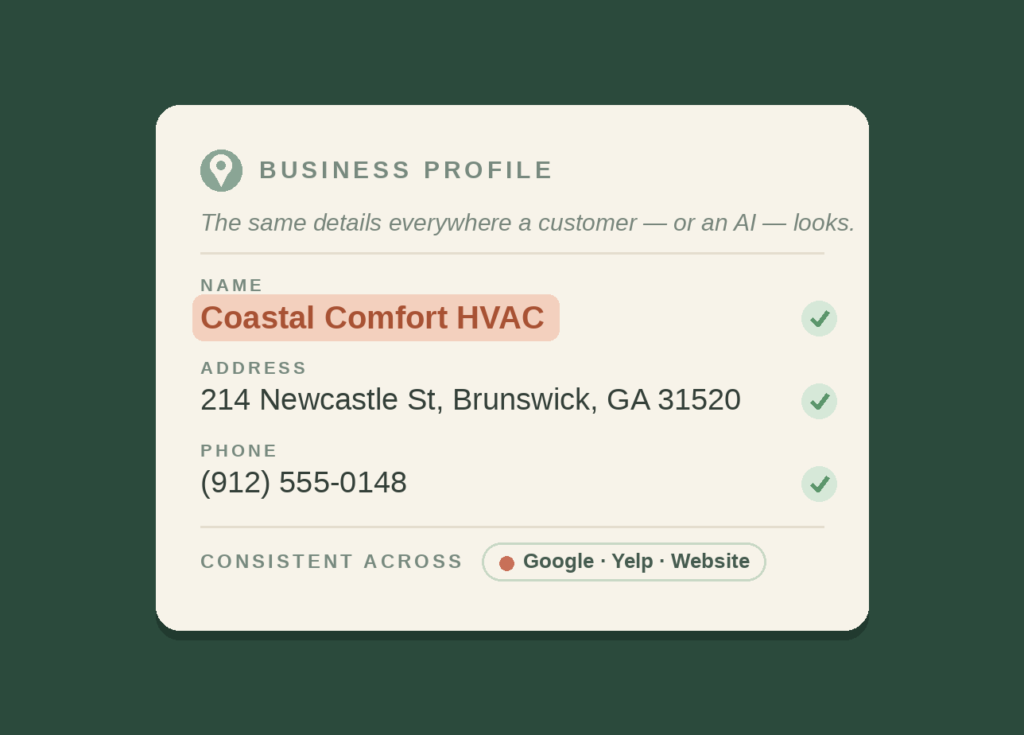
There’s a boring little detail that decides whether customers (and the AI assistants they now ask for recommendations) can trust that your business is real. It’s called NAP consistency, and it’s one of the highest-return fifteen minutes you’ll spend on your online presence all year.
What “NAP” actually means
NAP stands for Name, Address, and Phone number. NAP consistency means those three details appear exactly the same way everywhere your business shows up online: your website, your Google Business Profile, Yelp, Facebook, industry directories, and dozens of data sites you’ve never heard of.
“Exactly the same” is the part most owners miss. To a person, “123 Main St.” and “123 Main Street, Suite B” look like the same place. To a search engine or an AI model, they can look like two different businesses.
Why it matters more than it sounds like it should
For the humans
Mismatched info wastes a customer’s trust and their patience. If your website says you close at 6 but Google says 5, or an old listing rings a number that now belongs to a stranger, the customer doesn’t email you to sort it out. They call the next business on the list. Every wrong detail is a small leak, and the leaks add up.
For the algorithms and the AI
This is the part that’s changed. Google decides how prominently to show your business partly by how confidently it can tie all your listings, reviews, and mentions to one single business … you. When your NAP matches everywhere, Google connects the dots and trusts you. When it doesn’t, those signals turn into noise, and Google discounts noisy signals.
AI assistants like ChatGPT, Perplexity, and Google’s AI answers work the same way, only stricter. It’s one of the first things to fix if you want to get recommended by ChatGPT. They build their picture of your business by cross-referencing many sources, and when those sources disagree, the safest move for the AI is to leave you out of the answer entirely. It would rather name the business whose details line up cleanly than risk sending someone to the wrong address. Consistent NAP is one of the clearest signals you can give an AI that you’re a real, credible business worth recommending.
In plain terms: matching details don’t just help you rank. They’re increasingly what gets you mentioned at all.
What actually counts as a “mismatch”
The inconsistencies that hurt you are usually small and accidental. Watch for:
- Street vs. St., Suite vs. Ste., Avenue vs. Ave.
- A tracking or call-center number in one place and your real line in another
- An old address from before you moved, still living on a directory you forgot about
- Your business name with and without “LLC,” “& Sons,” or the city tacked on
- A cell number on Facebook and a landline on Google
- Two Google listings for the same business (more common than you’d think)
None of these feel like a big deal. All of them chip away at the confidence a search engine or AI has that your listings describe one real place.
The 15-minute NAP audit
You don’t need software or an agency for the first pass. Here’s the fifteen-minute version:
- Write down your “source of truth.” Decide the one exact format for your name, address, and phone, down to the abbreviation and suite number. Everything else gets matched to this.
- Fix your website first. Put the correct NAP in your site footer as plain text (not inside an image), so both people and AI can read it on every page.
- Check your Google Business Profile. This is the big one. Confirm the name, address, and phone match your source of truth exactly — and that there’s only one listing for your business.
- Update the big platforms. Facebook, Yelp, Apple Maps, Bing Places, and any industry directory you use.
- Search your own phone number and old address in quotes. Wrong or outdated listings will surface. Note them to claim or correct.
- Set a reminder to recheck quarterly. Info drifts. Five minutes every few months keeps it clean.
Do steps 1–3 today and you’ve handled most of the impact.
One step further
If you or your web person are comfortable with a little technical work, add LocalBusiness schema markup to your site. It’s a small piece of code that spells out your name, address, phone, hours, and service area in a format built specifically for search engines and AI to read without guessing. It’s the difference between hoping the machine reads your page correctly and handing it a labeled answer.
Quick answers
How exact does it really need to be?
Exact. Pick one format and use it letter-for-letter everywhere.
What if I’ve moved?
Update your Google profile and website first, then track down old listings with your former address and correct them.
Does this still matter with AI search?
More than ever. AI pulls from many sources and quietly skips businesses whose details don’t agree.
How often should I check?
A full audit once or twice a year, plus a quick look whenever anything changes — new number, new suite, new name.
The bottom line
Your name, address, and phone number are the plainest facts about your business, and getting them to line up everywhere is one of the least glamorous, highest-return things you can do to get found. It won’t make you go viral. It’ll just quietly make sure that when a customer, or the AI they’re asking, comes looking for you, they find one clear, trustworthy answer.
That’s the whole game.