
Nineteen HVAC companies serve Glynn County. Nine are never named by AI.
I asked ChatGPT, Perplexity, Google AI Mode and Gemini who to call for heating and air in Brunswick and St Simons. Then I opened the websites to work out why they answered the way they did.
No company is named on this page. The findings are exact.
What the engines said
19
companies serving Glynn County
5
own the Brunswick answer
4
own the St Simons answer
Roughly nine were never named once, by any engine, on any phrasing. Several of them have real websites with real addresses and real phone numbers on them.
What I expected to find, and did not
I expected this to be about who had the better website. It is not. Two of the companies that get named have no structured data at all, and one of them has a homepage that reads like it was never finished.
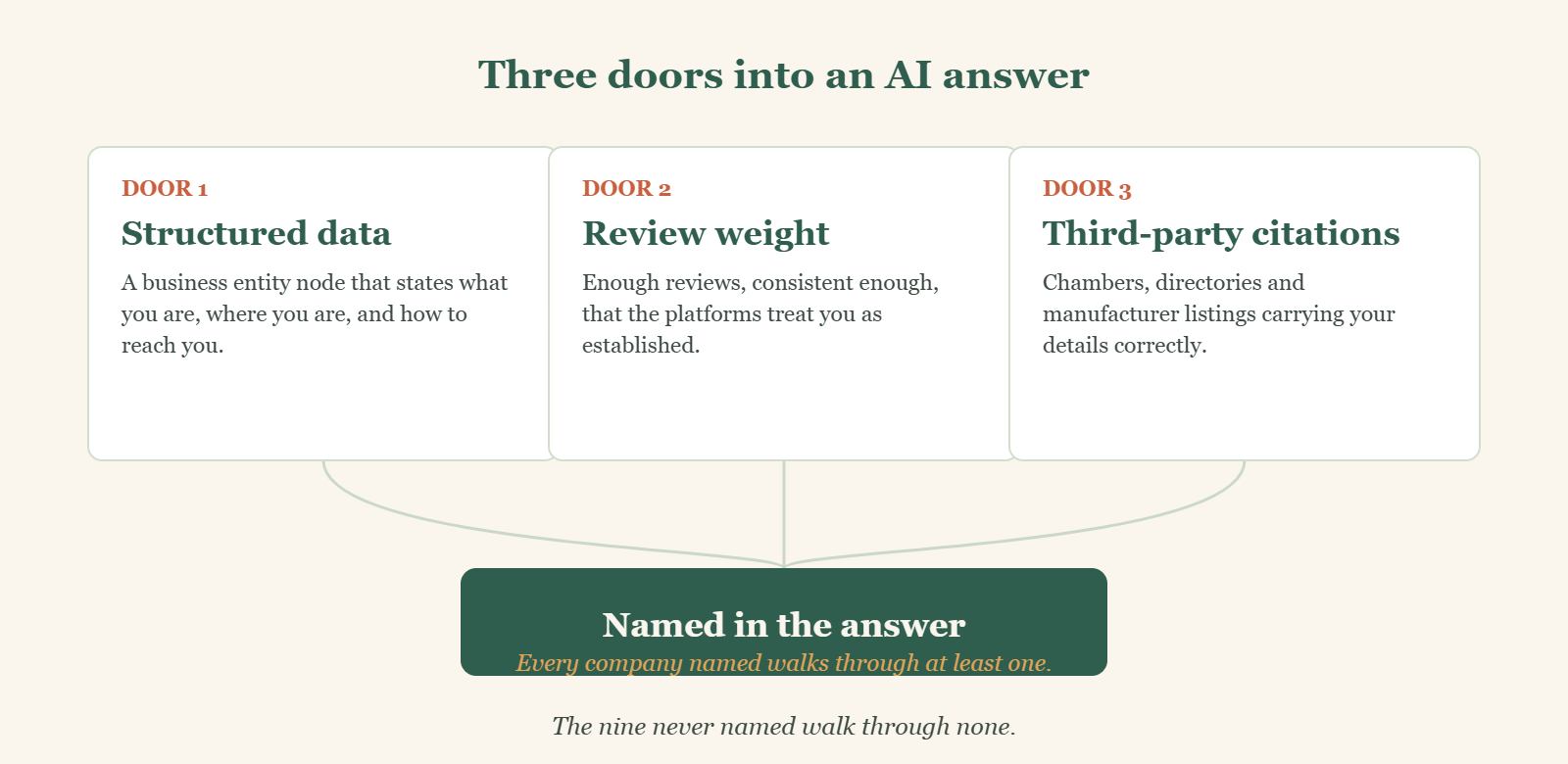
What the named companies have in common is not a good website. It is that something, somewhere, tells a machine what they are.
Three doors into an AI answer
Three findings, no names
FINDING ONE
Two AI tools give two different phone numbers for the same company
One company shows one phone number on its website. Its Google Business Profile shows a different one. Ask Gemini and you get the profile number. Ask Perplexity or Google AI Mode and you get the website number. Same business, same day, two answers.
Their markup has a page node, a website node and a breadcrumb trail. It has nothing that says this is a business, and nothing carrying a phone number. So nothing on their own site ever declared which number was right, and each engine picked a different source.
Neither engine is wrong. The business never gave an answer.
FINDING TWO
A company in business since 1978 is visible only because other people carry its data
In the HTML of this company’s homepage, a placeholder phone number appears fifteen times. The business name reads as an unfilled template field seven times. Their structured data exists but contains only a name and a web address. No phone, no address, no hours.
A script rewrites the placeholders once the page loads, so a person sees the correct numbers and nothing looks wrong. The corrected version never reaches the crawlers that do not run scripts.
Every engine still has their right phone number and address. They got it from the Chamber of Commerce and a manufacturer’s dealer directory. The off-site half is doing all of the work.
FINDING THREE
The company named first has no structured data at all
No business markup. No meta description. Two competing H1s on the homepage. Named first by two of the four engines.
They have 263 reviews at a five star average, which is more than double anyone else in the county. Review weight is its own kind of structure, and at that volume it is enough on its own.
This is the finding that stops the argument being simple. Good markup is not the only way in. It is just the only one you fully control.
Most of what a machine reads on these sites is not for you
On several of these websites, the majority of the text in the page source is template scaffolding that no visitor ever sees. Hidden slide captions, unused layout blocks, instruction text left in by the builder.
| Site | Text in the source | Text a visitor sees | Hidden |
|---|---|---|---|
| A | 33,300 characters | 3,200 | 90% |
| B | 18,000 characters | 2,900 | 84% |
| C | 12,700 characters | 4,200 | 67% |
On one of these, the word “Button” appears sixty-four times. On another, three carousel slides are captioned “Write your caption here.” Nobody did anything wrong. That is what the website builder shipped.
If you run one of these companies
Nothing here is a criticism of anyone’s work. Every business on this list is a real company doing real work, and none of these problems are visible from the front of a website. Here are three checks you can run yourself in about ten minutes.
- Ask ChatGPT who the best HVAC company in Brunswick is. Then ask it what your phone number and address are. If it does not know you, or gets it wrong, that is the whole problem in one screen.
- Compare the phone number on your website to the one on your Google Business Profile, character for character, including how it is formatted. Then check the directories that carry you.
- Right click your homepage, choose View Page Source, and search for schema.org. If nothing comes back, or the only thing there is your name and web address, a machine has no reliable way to know what you do or where you are.
If you find something and want a second pair of eyes on it, send it over. I will tell you what I see whether or not you hire anyone, including me.
Method and limits
- Roster built from Google Places, cross-checked against Chamber listings, BBB, Angi, and Carrier and Bryant dealer directories. Places alone was not exhaustive. Two companies were found only through other sources.
- Ten of nineteen websites were examined in detail. Each was read twice, once as served and once as rendered in a browser, because those are different documents and the difference is usually the finding.
- AI results come from ChatGPT, Perplexity, Google AI Mode and Gemini, asked two ways each, on 12 September 2026. AI answers change. Yours may differ.
- Review counts and profile hours are from Google Places on 12 September 2026.
- No company is named. Findings are reported exactly, attributed to nobody.
Want to know where you sit?
Send your business name and your website. I run the same check by hand across ChatGPT, Perplexity, Google AI Mode and Google Search the way a customer would ask, and tell you whether you show up, who shows up instead of you, and which sources those tools are citing. No charge and no call required.